Quechua
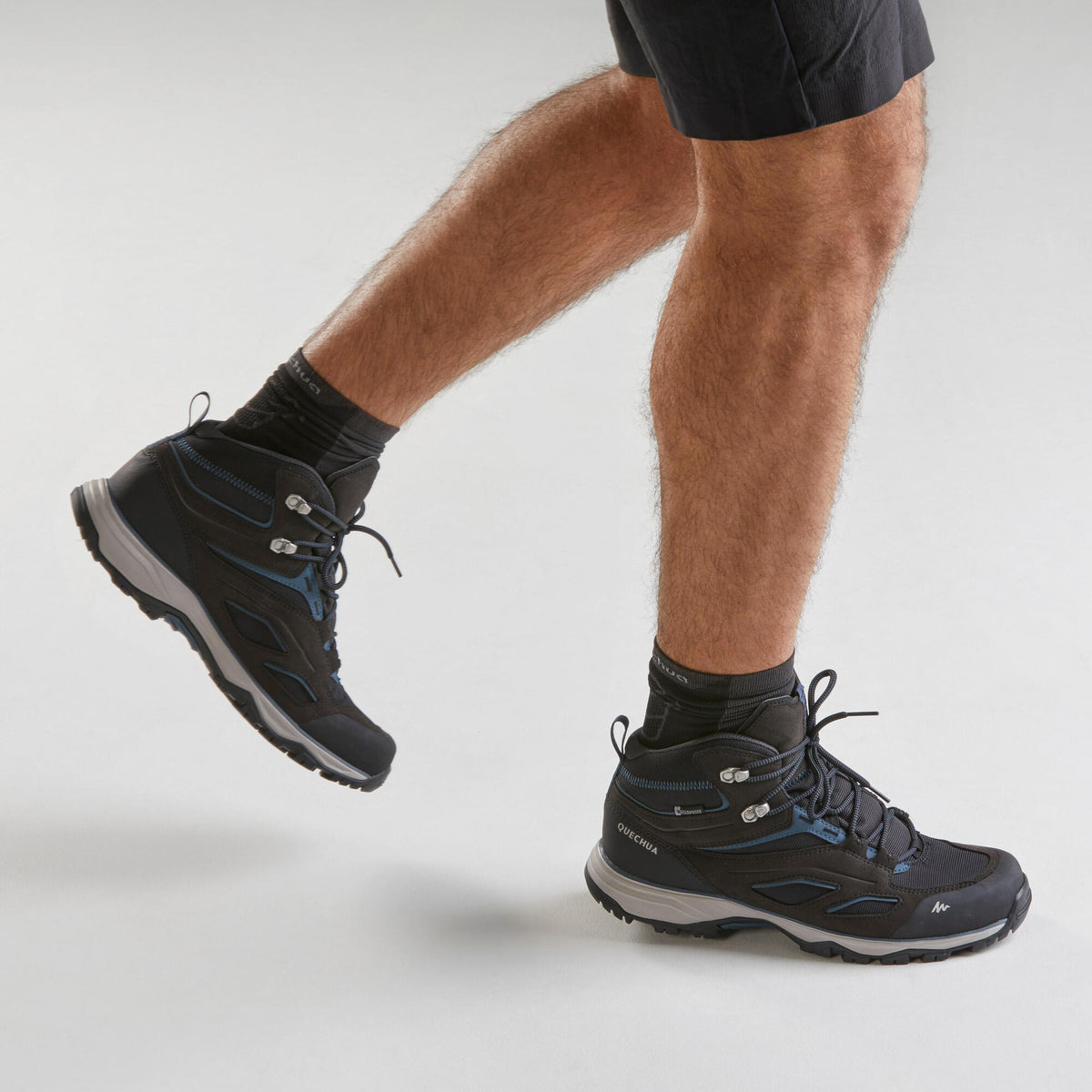
Quechua Men's MH100 Waterproof Mid Hiking Boots
Quechua Men's MH100 Waterproof Mid Hiking Boots
Couldn't load pickup availability
1 in stock
Description
Highlights:
- Lightweight: 15.5 oz (440 g) per shoe in size 9.5 (EU 42.5)
- Waterproof and breathable membrane lining: your feet dry for 3 hr in all weath
- Traction: Non-slip rubber outsole with 5 mm gripping studs.
- Fit: High-rise upper. Locking hooks to restart the lacing between foot and ankle
Key Features
| Traction | Non-slip rubber outsole with 4mm gripping studs. |
| Durability | Durable rubber toe bumper at the front of the foot. |
| Waterproof | Waterproof and breathable membrane lining: your feet dry for 3h in all weather |
| Fit | High-top upper. Locking hooks to spread lacing between the foot and ankle |
| Cushioning | Full length cushioning thanks to an EVA midsole. |
| Lightweight | 440 gr per shoe in size 43 |
| Hiking frequency and intensity | We have classified our products in terms of performance and features for 3 levels of Mountain Walking:- occasional: about 10 hikes per year of about 3 to 4 hours in length, covering less than 10km and less than 700m in elevation gain.- Regular: about 20 outings per year. 4 to 6 hours, 10 to 20 km, 700 to 1200m of elevation gain per outing.- Intensive: more than 20 times a year. More than 6 hours, more than 20 km, 1200 to 2000m of elevation gain per outing. |
| Sole with grip | The grip of our soles is certified. To be awarded certification, the boots must pass laboratory tests to assess the grip rate on different surfaces (Smooth, Rugged, Dry, Wet). To validate these tests, we assess the quality of our soles in the field, the mountains, by a panel of representative testers over 500 km. |
| Waterproofing test | In a laboratory, the shoe is immersed in water to mid-height on a mechanical arm that flexes to simulates a number of steps. With this test we can determine a time and number of km that the boot can walk while staying dry. Then we confirm in the field or under the rain, that the shoe meets its promises. |
| Making waterproofing last longer | To keep your feet dry, we advise you to use a waterproof gaiter or mini-gaiter to protect the top of your boots and prevent water, pebbles and sand from getting in.We advise re-waterproofing your boots twice a year using a re-waterproofing agent (search for ‘waterproofing’ on our Decathlon website) which will help you restore the original water-repellent qualities and help prevent stains on the outside. |
| Which size should i select? | The most important thing is to try on several sizes and styles of boots to find the one most suited to you! You can take a size above your usual one to prevent the toes from bumping into the toe box when going downhill, provided the foot is properly supported to avoid friction.Tip: keep your toenails short and, before a long descent, check that your lacing is tight enough to prevent your foot from sliding forwards inside the boot. |
| Buying tips / how do you try your boots on? | Some Decathlon stores have a test route.1. Try on both shoes, standing up, with the socks worn for hiking. 2. Tighten the laces, taking care to correctly balance the tightening.3. Check two points:- the heel does not come up before the shoe when you walk uphill.- the foot does not slide and the toes do not press against the front when going downhill.4. Try on several sizes and models.Break them in gradually to adapt them to your foot. |
| Which socks? | A waterproof shoe will be less breathable than a non-waterproof shoe. Socks like the MH500, MH520 and MH900 with a high or medium upper (adapted to the height of the boot) are therefore preferable for wicking away perspiration and reducing friction. |
| Optimise the capabilities of your boots: replace your insoles! | The original insole in your shoes is designed to accommodate most feet. A change of insole can bring:1. Improved support: some soles are preformed or reinforced to better support the arch of the foot. 2. More comfort: the insoles can also provide heat and/or cushioning.3. Longer life: restore the support and comfort of your shoes by replacing the insole each season. |
| How should you look after your shoes? | - Leave to air dry.- Remove dry mud with a stiff brush. - Clean marks using a brush and some warm water- Leave to dry- Spray with a re-waterproofing product to restore the water-resistance to the upper. |
| Product Testing | All our models are tested by users representative of our target market in conditions identical to those you encounter yourself when using them. We believe that carrying out 'real-life' testing is the only way to design and continuously advance the technical relevance and design of all our Quechua products. |
| Storage Instructions | Store in a dry place away from sunlight. |
| Origin | Imported |
| Outer sole | 67.0% Synthetic Rubber, 33.0% Ethylene Vinyl Acetate |
| Upper | 82.9% Polyamide, 7.1% Polyurethane, 10.0% Synthetic Rubber |
| Lining and sock | 100.0% Polyester |
Highlights
Traction
Non-slip rubber outsole with 4mm gripping studs.
Durability
Durable rubber toe bumper at the front of the foot.
Waterproof
Waterproof and breathable membrane lining: your feet dry for 3h in all weather
Fit
High-top upper. Locking hooks to spread lacing between the foot and ankle
Cushioning
Full length cushioning thanks to an EVA midsole.
Lightweight
440 gr per shoe in size 43
Materials & care
Outer sole of: 67.0% Synthetic Rubber, 33.0% Ethylene Vinyl Acetate
Upper of: 82.9% Polyamide, 7.1% Polyurethane, 10.0% Synthetic Rubber
Lining and sock of: 100.0% Polyester
Size chart
Smartsize
Size Guide
Womenswear size guide
To take your measurements
1. Head: Wrap a tape measure around your head, above eyebrows. Make sure it is parallel with the floor when your head is straight.
2. Bust: Wrap a tape measure around your back and bring forward to the fullest part or your bust. Make sure it's straight and parallel with the floor. Raise your head, tight the tape and breathe normally.
3. Under bust: Directly below the bust. wrap a tape measure around the ribcage. Make sure it's straight and parallel with the floor. Raise your head, tighten the tape and breathe normally.
4. Waist: Wrap a tape measure around your narrowest part of your waist, above your belly button. Raise your head, tighten the tape and breathe normally.
5. Hips: Wrap a tape measure around the fullest part of your hips
6. Hand: Hold a tape measure at the bend of the thumb. Wrap around your palm.
7. Feet: Stand against a wall, heels touching the wall. Put an object (e.g book...) against your longest toe. Measure the length between the wall and the object.
Women sportswear
Top, tee shirts, sweaters, jackets, suits...
| 2XS | XS | S | M | L | XL | 2XL | 3XL | 4XL | 5XL | |
|---|---|---|---|---|---|---|---|---|---|---|
| Chest (cm) | 71 – 77 | 77 – 82 | 82 – 88 | 88 – 94 | 94 – 101 | 101 – 108 | 108 – 116 | 116 – 125 | 125 – 134 | 134 – 143 |
| Waist (cm) | 60 – 64 | 64 – 68 | 68 – 73 | 73 – 78 | 78 – 85 | 85 – 92 | 92 – 101 | 101 – 111 | 111 – 120 | 120 – 129 |
| Chest (in) | 28 – 30.3 | 30.3 – 32.3 | 32.3 – 34.6 | 34.6 – 37 | 37 – 39.8 | 39.8 – 42.5 | 42.5 – 45.7 | 45.7 – 49.2 | 49.2 – 52.8 | 52.8 – 56.3 |
| Waist (in) | 23.6 – 25.2 | 25.2 – 26.8 | 26.8 – 28.7 | 28.7 – 30.7 | 30.7 – 33.5 | 33.5 – 36.2 | 36.2 – 39.8 | 39.8 – 43.7 | 43.7 – 47.2 | 47.2 – 50.8 |
... (size chart continues with multiple tables for women's, men's, children's, footwear, accessories)
What is your hiking frequency and intensity?
We have classified our products in terms of performance and features for 3 levels of Mountain Walking:- occasional: about 10 hikes per year of about 3 to 4 hours in length, covering less than 10km and less than 700m in elevation gain.- Regular: about 20 outings per year. 4 to 6 hours, 10 to 20 km, 700 to 1200m of elevation gain per outing.- Intensive: more than 20 times a year. More than 6 hours, more than 20 km, 1200 to 2000m of elevation gain per outing.
Sole with grip
The grip of our soles is certified. To be awarded certification, the boots must pass laboratory tests to assess the grip rate on different surfaces (Smooth, Rugged, Dry, Wet). To validate these tests, we assess the quality of our soles in the field, the mountains, by a panel of representative testers over 500 km.
Waterproofing test
In a laboratory, the shoe is immersed in water to mid-height on a mechanical arm that flexes to simulates a number of steps. With this test we can determine a time and number of km that the boot can walk while staying dry. Then we confirm in the field or under the rain, that the shoe meets its promises.
Making waterproofing last longer
To keep your feet dry, we advise you to use a waterproof gaiter or mini-gaiter to protect the top of your boots and prevent water, pebbles and sand from getting in.We advise re-waterproofing your boots twice a year using a re-waterproofing agent (search for ‘waterproofing’ on our Decathlon website) which will help you restore the original water-repellent qualities and help prevent stains on the outside.
Which size should i select?
The most important thing is to try on several sizes and styles of boots to find the one most suited to you! You can take a size above your usual one to prevent the toes from bumping into the toe box when going downhill, provided the foot is properly supported to avoid friction.Tip: keep your toenails short and, before a long descent, check that your lacing is tight enough to prevent your foot from sliding forwards inside the boot.
Buying tips / how do you try your boots on?
Some Decathlon stores have a test route.1. Try on both shoes, standing up, with the socks worn for hiking. 2. Tighten the laces, taking care to correctly balance the tightening.3. Check two points:- the heel does not come up before the shoe when you walk uphill.- the foot does not slide and the toes do not press against the front when going downhill.4. Try on several sizes and models.Break them in gradually to adapt them to your foot.
Which socks?
A waterproof shoe will be less breathable than a non-waterproof shoe. Socks like the MH500, MH520 and MH900 with a high or medium upper (adapted to the height of the boot) are therefore preferable for wicking away perspiration and reducing friction.
Optimise the capabilities of your boots: replace your insoles!
The original insole in your shoes is designed to accommodate most feet. A change of insole can bring:1. Improved support: some soles are preformed or reinforced to better support the arch of the foot. 2. More comfort: the insoles can also provide heat and/or cushioning.3. Longer life: restore the support and comfort of your shoes by replacing the insole each season.
How should you look after your shoes?
- Leave to air dry.- Remove dry mud with a stiff brush. - Clean marks using a brush and some warm water- Leave to dry- Spray with a re-waterproofing product to restore the water-resistance to the upper.
Product Testing
All our models are tested by users representative of our target market in conditions identical to those you encounter yourself when using them. We believe that carrying out 'real-life' testing is the only way to design and continuously advance the technical relevance and design of all our Quechua products.
Storage Instructions
Store in a dry place away from sunlight.
Origin
Imported
Share